Why Tomatoes Split After a Late-Summer Rain
Quick Answer: Tomatoes split when the inside of the fruit grows faster than the skin can stretch. That happens when a plant goes through a dry period, the skin firms up and loses elasticity, and then a heavy rain delivers a sudden surge of water the roots push straight into the fruit. The fix is consistency rather than volume - steady moisture, heavy mulch, and picking fruit at first blush when heavy rain is forecast. Variety matters too, and some tomatoes will split no matter what you do.
You walk out after an overnight downpour and half the crop has opened up.
They were fine yesterday. Nothing bit them, nothing is diseased.
The skin simply could not keep up.
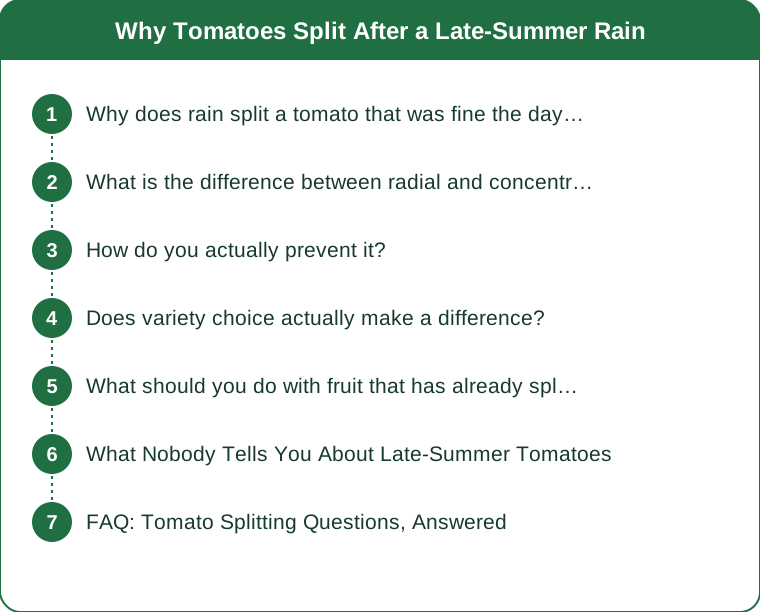
Why does rain split a tomato that was fine the day before?
Because the skin and the flesh grow on different schedules, and rain breaks the truce between them.
A tomato skin is a fixed-area membrane that expands slowly. The flesh inside is mostly water held in cells that can fill quickly. In normal conditions the two keep pace because water arrives gradually and the skin has time to stretch.
A dry period changes the skin. When soil moisture drops, the fruit’s outer layer firms up and becomes measurably less elastic - it is a protective response that reduces water loss. The plant is defending itself against drought, and the cost is a stiffer skin.
Then the rain arrives. Roots that have been searching for water suddenly find plenty of it, and the plant moves that water upward fast. Ripening fruit is a priority destination. The flesh swells within hours; the stiffened skin cannot stretch that quickly; it fails.
Which is why the pattern is so specific:
- Splitting follows a dry-then-wet sequence, not rain alone
- It hits fruit that is at or near ripe, because those have the thinnest skin relative to volume
- It happens overnight, since that is when water uptake is highest and transpiration lowest
- Green fruit rarely splits because the skin is still actively growing
The overnight detail matters more than people realise. During the day, leaves transpire heavily and pull water through the plant and out into the air. At night that release mostly stops, but the roots keep absorbing. Water that has nowhere else to go ends up in the fruit, which is why you find the damage at breakfast rather than at dusk.
And it is worth naming what splitting is not. It is not a disease, not a pest, and not a sign that you did something wrong with feeding. It is a plumbing problem - too much water arriving too fast into a container that had stopped being flexible.
What is the difference between radial and concentric cracking?
Two patterns, two slightly different causes, and one of them tells you more about your watering.
Radial cracks run from the stem end down the shoulder of the fruit, like spokes. These are the deep ones, the ones that open into the flesh and let in bacteria within a day. Radial cracking is the classic sudden-water-surge signature and is strongly associated with a heavy rain after dry weather.
Concentric cracks form rings around the stem end. These are usually shallower and often heal over into corky brown lines that look bad but do not ruin the fruit. Concentric cracking is more about temperature swing and slow chronic overfilling than about one dramatic event.
Reading your own crop:
- Mostly radial, appearing all at once - a watering consistency problem, or simply the weather
- Mostly concentric, appearing gradually - large day-night temperature swings, common as late summer turns
- Both, on the same fruit - the plant has been through repeated dry-wet cycles all season
Position on the plant is informative too. Fruit highest on the vine and most exposed to direct sun splits more, because sun-warmed skin loses elasticity fastest. Fruit tucked under foliage splits noticeably less, which is a genuine argument against aggressive pruning of upper leaves in a hot summer.
Size is a factor you cannot argue with. Large beefsteak types split far more than cherry or plum types for straightforward geometry reasons - a bigger fruit has more volume behind every square centimetre of skin, so the same percentage increase in water content puts far more strain on the surface.
And ripeness is the strongest single predictor. A tomato within two or three days of full colour is at maximum vulnerability. This is the practical hook the whole prevention strategy hangs on, and it is covered below.
How do you actually prevent it?
Consistency beats quantity, and mulch does more work than the watering can.
Water on a schedule rather than in response to wilting. The damage comes from the swing, not from the average. A plant kept at moderate steady moisture splits far less than one that alternates between dry and soaked, even if the second one gets more water overall.
A workable routine for in-ground plants in late summer:
- Deep watering every two to three days rather than a light daily sprinkle
- Roughly 25 to 40mm per week total including rainfall, adjusted upward in a heatwave
- Water in the morning, which lets the plant use it during the day rather than pushing it into fruit overnight
- Water at the base, never on the foliage, for disease reasons unrelated to splitting
Containers need a different approach entirely. A pot dries out and rewets far faster than open ground, which makes splitting more likely and more frequent. Daily watering, larger containers - 40 litres or more for an indeterminate variety - and a saucer to buffer are all meaningful improvements.
Mulch is the highest-return single change. A 5 to 8cm layer of straw, shredded leaves or compost around the base does three things at once: it slows evaporation, it buffers the soil against sudden rain entry, and it moderates soil temperature. In practice a heavily mulched bed will show noticeably less splitting than a bare one in the same weather.
And the one that feels like cheating: pick early when rain is forecast. A tomato at first blush - showing colour but still firm - will ripen perfectly on a kitchen counter over two or three days. Flavour development is largely complete once the fruit begins colouring, so the loss is small and the crop is saved. Check the forecast, and clear the near-ripe fruit the afternoon before a storm.
Does variety choice actually make a difference?
Substantially, and it is the one decision you make in spring that pays off in August.
Skin thickness and elasticity vary enormously between types, and breeders have selected for crack resistance in many modern varieties. The label to look for is crack resistant or split resistant, which is a real trait rather than marketing.
The general hierarchy, most resistant to least:
- Cherry and grape types split the least in absolute terms per fruit, though a whole truss can go at once
- Plum and paste types are generally good, with thicker skins bred for processing
- Mid-size slicers are variable and depend heavily on the specific variety
- Large beefsteaks split the most, and heirloom beefsteaks most of all
Heirlooms deserve a specific note. Many were selected for flavour over durability long before crack resistance was a breeding goal, and some of the best-tasting varieties are the worst offenders. This is a genuine trade-off rather than a flaw - if you grow a large heirloom, plan on losing some fruit to splitting and pick early aggressively.
Determinate versus indeterminate matters less than people assume, though determinate types concentrate their ripening, which means a badly timed storm can hit a much larger share of the crop at once.
A practical planting note for next season: if splitting has been a recurring problem, plant a mix. A crack-resistant variety for reliable volume alongside one heirloom for flavour gives you insurance without giving up the thing you actually grow tomatoes for.
And on grafted plants: grafted tomatoes with vigorous rootstock can actually split slightly more, because the root system moves water more aggressively. Excellent for yield, marginally worse for cracking - worth knowing rather than worth avoiding.
What should you do with fruit that has already split?
Move fast, and sort by depth rather than by appearance.
A fresh split is a clean wound and the fruit is entirely edible. The problem is that it becomes an entry point for bacteria and fungi within hours, and fruit flies find it almost immediately. The window is about a day in warm weather, less in humidity.
Triage as follows:
- Shallow concentric rings, already corked over and dry - leave on the vine, ripen normally, entirely fine
- Fresh deep radial split, flesh clean and firm - pick immediately, use within 24 hours
- Split with any visible mould, cloudiness or fermented smell - compost it, do not cut around it
- Split that has been open through a wet night - assume it is compromised
Cut away the split section generously and use the rest. Splits are ideal for anything cooked - sauce, roasting, soup - since texture no longer matters. A batch of split tomatoes roasted with garlic and frozen is the standard answer and turns a bad morning into next winter’s dinner.
What not to do: do not leave split fruit on the plant to see if it improves. It will not, and rotting fruit on the vine attracts pests and can spread fungal problems to healthy neighbours.
Clean up fallen fruit from the soil surface too. Rotting tomatoes at the base of a plant are a reservoir for problems that carry into next season, and it takes two minutes.
One genuinely useful habit: check the plants the morning after any heavy rain, every time. It becomes automatic after a season, and it is the difference between losing a few fruit and losing a week’s harvest.
What Nobody Tells You About Late-Summer Tomatoes
Six things that change once the season starts to turn.
Splitting gets worse as the season progresses, not better. Older plants have larger root systems and move more water, and late-season weather brings bigger swings. The same variety that behaved in July will crack in late August.
Reducing water late in the season improves flavour and reduces splitting at the same time. Slightly restricting water once fruit has set concentrates sugars. This is one of the few places where two goals point in the same direction - but do it gradually, since a sudden restriction followed by rain is the exact splitting recipe.
Removing lower leaves helps airflow and hurts splitting. Better circulation reduces disease; less shade increases skin temperature and reduces elasticity. Prune the lowest leaves for disease management and leave the upper canopy alone.
Big day-night temperature swings cause splitting on their own, with no rain involved at all. As nights cool in late summer, the fruit contracts and expands daily. This is the main driver of the concentric ring pattern and it is largely out of your control.
Overfeeding with nitrogen makes it worse. Heavy nitrogen drives soft, fast growth including softer fruit walls. Late in the season, potassium-leaning feeds serve the fruit better than growth-focused ones.
And the one that surprises people: a soaker hose on a timer solves this problem more reliably than any amount of attentive hand watering. The mechanism is entirely about consistency, and a machine is simply better at consistency than a person with a busy week.
FAQ: Tomato Splitting Questions, Answered
Are split tomatoes safe to eat?
Yes, if the split is fresh and the flesh is clean and firm. Cut away the damaged area generously and use the rest within a day. Discard anything showing mould, cloudy flesh or a fermented smell rather than cutting around it.
Can I stop splitting if it rains heavily no matter what I do?
Not entirely, but you can reduce it a lot. Heavy mulch, consistent watering between rain events, and picking near-ripe fruit before a forecast storm together prevent most of the damage. Weather is a factor you manage rather than control.
Why do only some plants split when they get the same water?
Variety is the biggest reason - skin thickness and elasticity differ substantially between types, and large beefsteaks split far more than cherry or plum varieties. Position matters too, since sun-exposed fruit high on the vine has less elastic skin.
Should I water more or less to prevent cracking?
More consistently, which usually means less at any one time and more often. The damage comes from the swing between dry and soaked, not from the total amount. Deep watering every two to three days beats a heavy soak once a week.
Does picking tomatoes early hurt the flavour?
Barely. Once a tomato begins showing colour, sugar development is largely complete and it will finish ripening on a counter over two or three days. Picking at first blush ahead of a storm costs very little and saves the fruit.
Is concentric cracking a different problem from radial cracking?
Related but not identical. Radial cracks running down from the stem come from sudden water surges and are the deeper, more damaging type. Concentric rings around the stem come more from temperature swings and are usually shallow enough to cork over harmlessly.
TL;DR:
- Splitting happens when flesh swells faster than skin can stretch, after a dry spell followed by heavy rain
- Overnight is when it happens, because roots keep absorbing while leaves stop releasing
- Radial cracks from the stem mean sudden water surges; concentric rings mean temperature swings
- Consistency prevents it - steady watering, 5 to 8cm of mulch, morning watering at the base
- Pick fruit at first blush when heavy rain is forecast; it ripens fine on a counter
- Large beefsteaks and heirlooms split most, cherry and plum types least
- Use split fruit within a day, cooked, and clear fallen fruit from the soil
The rain is not really the problem. The dry week before it is.
Keep Reading
This article is for general informational and styling purposes only. Fit, sizing, and product availability may vary.