The Complete Guide to Planting Garlic and Bulbs for Next Spring
Quick Answer: Garlic and spring bulbs are the only crops where the entire result is determined by decisions you make in autumn and nothing you do in spring can fix them. Garlic goes in 2-4 weeks before your ground freezes - for most of the northern US that is mid-October to early November - at 5cm deep, 15cm apart, pointy end up. Spring bulbs go in when soil temperature drops below 15C, at three times their own height deep. The three failures that ruin it are planting too early, planting too shallow, and planting into soil that holds water.
Right now, in mid-August, you are in the planning and preparation window rather than the planting one - and preparation is where most of the difference is actually made.
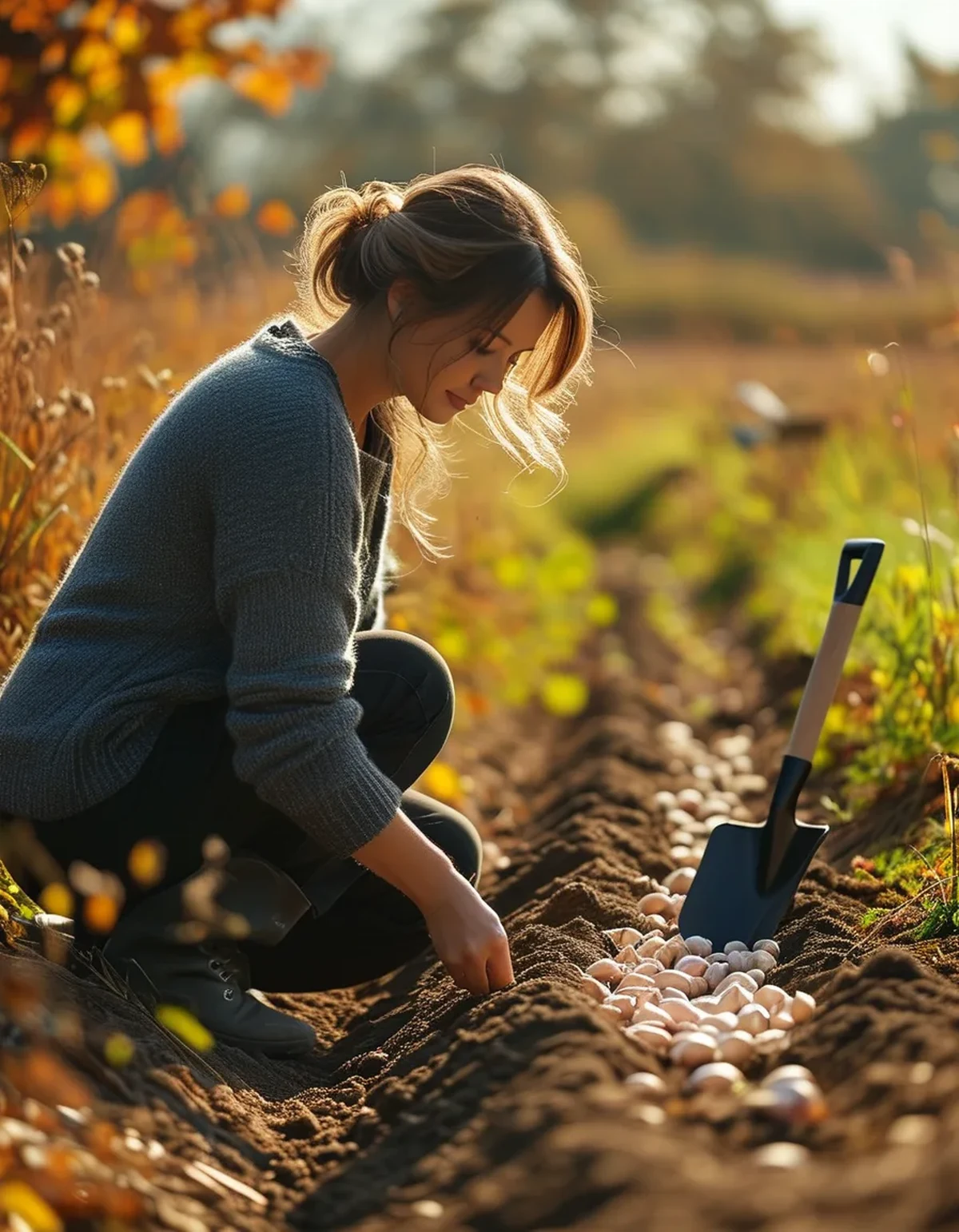
Why is autumn planting completely different from spring planting?
Because you are not planting a crop that grows now. You are installing something that spends the winter doing invisible work, and the work it does depends entirely on how you set it up.
Garlic and spring bulbs both need a cold period to perform. Garlic requires roughly 6-8 weeks below 10C to trigger the signal that splits a single clove into a multi-clove bulb. Skip that cold period - plant in spring instead - and you get one large round instead of a proper head. It is edible, but it is not what you wanted.
Spring bulbs need a similar vernalisation. Tulips, daffodils, alliums, and crocus all require sustained cold to initiate flowering. This is why bulbs sold in warm climates come pre-chilled, and why they behave as annuals there.
Root growth happens in autumn, not spring. This is the part that surprises people. A garlic clove planted in October puts down a substantial root system through November and December, in soil that is cold but not frozen. When the ground warms in March, that plant already has roots and can grow immediately. A spring-planted clove spends March and April building the root system your autumn planting finished five months ago.
The practical consequence: an autumn-planted garlic crop typically yields two to three times what the same variety yields planted in spring. That is not a marginal improvement, it is the whole point.
What this means for right now: nothing you do in April fixes an October mistake. There is no rescue, no feeding regime, no watering schedule that recovers it. The season is decided before winter, which is exactly why it is worth doing carefully.
One more thing worth knowing: this same logic is why autumn is the best time to plant perennials, shrubs, and trees generally. Warm soil, cool air, and months of root establishment before the plant is asked to support foliage. Autumn planting is the most underused advantage in the whole garden year.
When exactly should you plant, and how do you know?
Timing is the single most common failure, and it fails in both directions.
The garlic rule: 2-4 weeks before your ground freezes solid. You want enough time for roots to establish, but not so much that the plant puts up substantial top growth before winter. A few centimetres of green shoot is fine and normal. Fifteen centimetres of lush leaf going into a hard freeze is a problem.
By region, roughly: northern states and southern Canada, late September to mid-October. Middle latitudes including most of the Midwest and the mid-Atlantic, mid-October to early November. Southern states, November into December - and in zones 8 and warmer you generally need to pre-chill your seed garlic in the fridge for 6-8 weeks because the ground will never get cold enough.
A better method than the calendar: use soil temperature. Plant garlic when the soil at 10cm depth is consistently around 10-15C and falling. A cheap soil thermometer removes all the guesswork, and it adjusts automatically for the fact that autumn arrives at a different date every year.
Spring bulbs are more forgiving but follow the same principle. Plant when soil drops below 15C, which is typically 4-6 weeks before hard frost. Daffodils and alliums are best planted earlier in that window; tulips genuinely prefer to go in late, often as late as early December in milder areas, because late planting reduces the risk of fungal problems.
Planting too early is the more damaging error. Warm soil pushes top growth, that growth gets killed by the first hard freeze, and the bulb spends stored energy replacing it. You end up with a weakened plant that yields poorly.
Planting too late is survivable. A garlic clove planted in December in cold ground will usually still come up, just with a smaller root system and a smaller final head. If you miss the window, plant anyway - late is far better than never or than spring.
What you should be doing in mid-August: ordering seed garlic. Good varieties from good suppliers sell out by early September, and the difference between quality seed stock and supermarket garlic is one of the largest single variables in the whole project.
What soil preparation actually matters?
This is the work that happens now, and it matters more than anything you do on planting day.
Drainage is the non-negotiable. Garlic and bulbs sitting in waterlogged winter soil rot. This is the number one killer, above cold, above pests, above everything. If your bed puddles after rain and stays wet for more than a few hours, you need to fix that before you plant anything into it.
How to fix it: raise the bed. Even 15-20cm of height above the surrounding soil transforms winter drainage. Add coarse organic matter - compost, leaf mould, well-rotted manure - which improves structure in both directions, draining heavy soil and holding moisture in sandy soil.
Do not add fresh manure. It burns roots and encourages soft growth. Well-rotted only, and ideally worked in several weeks before planting.
Feed the bed now, not at planting. Garlic is a heavy feeder, particularly of nitrogen, but it wants that nitrogen available in spring when it is growing leaves. Work in compost and a balanced organic fertiliser now, let it integrate over the autumn, and top-dress with a nitrogen source in early spring when shoots appear.
Test your pH if you never have. Garlic wants 6.0-7.0. Bulbs are similar. A soil test costs very little and it is the only way to know whether your beautiful compost programme is being undermined by a pH that locks out nutrients. Late summer is the ideal time to test, because if you need lime it takes months to act.
Rotation matters more than people expect. Do not plant garlic where onions, leeks, shallots, or garlic grew in the previous two years. Allium diseases - white rot in particular - persist in soil for years and there is no cure. If you have had a problem, move to a completely different bed or grow in containers.
Clear the bed properly. Perennial weed roots left in place will spend the winter establishing while your garlic does the same, and you will spend spring fighting them at exactly the moment your crop cannot handle competition.
Mulch material should be sourced now. You will want 10-15cm of straw or shredded leaves over the bed after planting. Autumn leaves are free and ideal, but you need to collect them at the right moment. Plan for it.
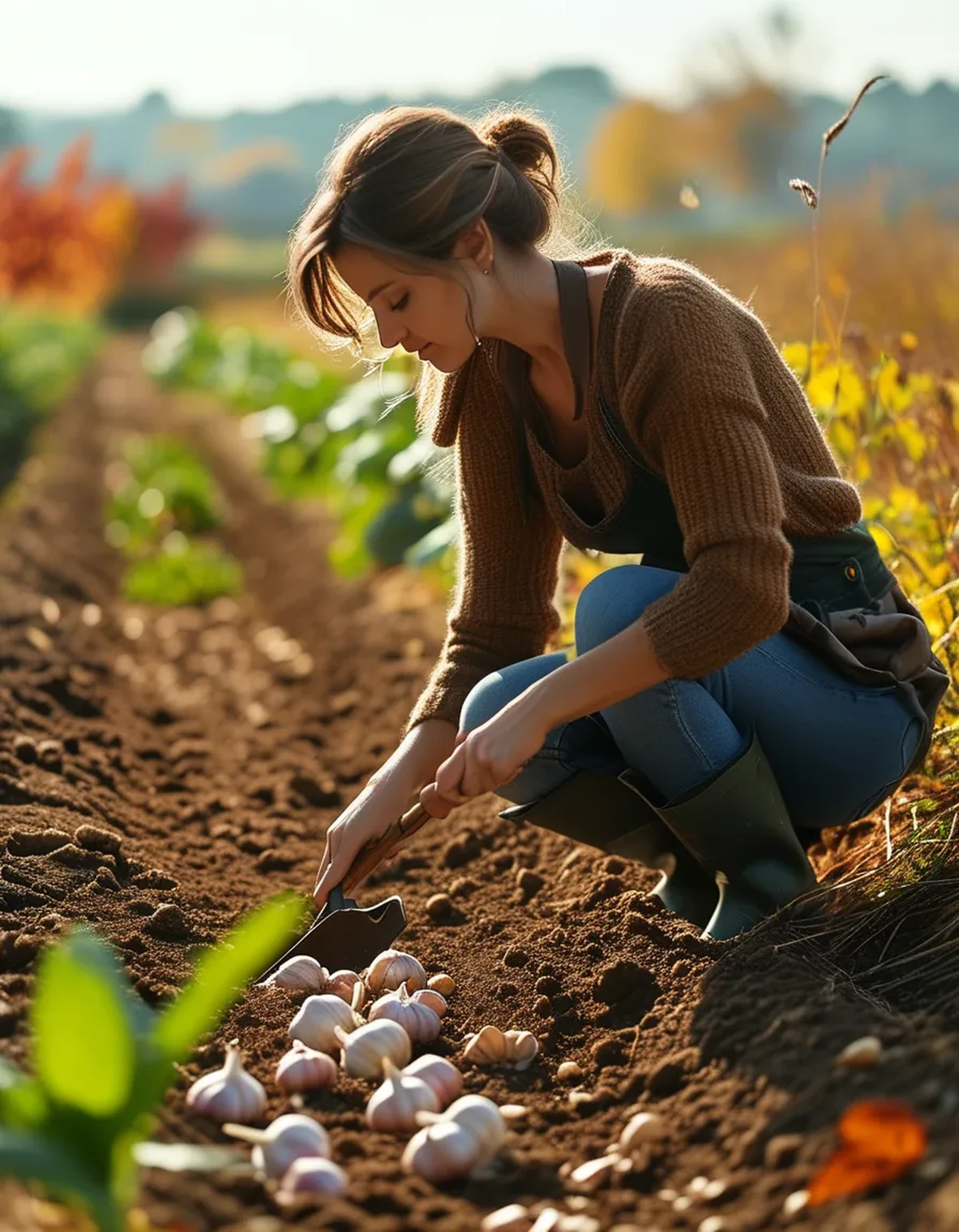
How deep, how far apart, and which way up?
The mechanics, precisely, because approximation costs yield.
Garlic depth: 5cm from the top of the clove to the soil surface, in most climates. In cold regions with unreliable snow cover, go to 8-10cm for insulation. Too shallow is the risk - a clove at 2cm can be heaved out of the ground entirely by winter freeze-thaw cycles, which is a specific and common failure.
Garlic spacing: 15cm apart in rows 25-30cm apart. Tighter spacing produces smaller heads, straightforwardly and predictably. If you have limited space, plant fewer cloves properly rather than more cloves crowded.
Orientation: pointy end up, flat root plate down. This matters. A clove planted upside down will usually still grow, but it wastes energy turning itself around and produces a smaller, often distorted head.
Break the head into cloves the day you plant, not before. Cloves separated weeks in advance dry out at the root plate and start poorly. Plant the largest cloves only - clove size directly predicts head size, and the small inner cloves are better used in the kitchen.
Do not peel them. The papery wrapper is protection. Leave it on.
Spring bulb depth: three times the height of the bulb. A 5cm tulip bulb goes 15cm deep. This rule is more important than people think - shallow-planted tulips are the primary reason tulips fail to return in year two, because shallow bulbs are more likely to split into non-flowering offsets.
Bulb spacing: roughly two to three bulb-widths apart. Closer for a dense display in a border, wider if you want them to naturalise and spread over years.
Plant bulbs in groups, not lines. Odd numbers, clustered - 7, 9, or 11 bulbs in an irregular group reads as natural. A single row of tulips along a path reads as municipal planting, which is a look, but rarely the intended one.
Water once at planting, thoroughly, then largely leave it. Autumn rain usually handles the rest. Only water again if you get an unusually dry autumn - and if you do, water deeply and infrequently rather than lightly and often.
5 Mistakes That Cost You the Whole Season
1. Using supermarket garlic. Grocery store garlic is frequently treated with sprout inhibitors, is often a softneck variety selected for shipping rather than flavour or cold-hardiness, and can carry disease. Buy proper seed garlic from a supplier - it costs more, and it is the highest-return money in the entire project. It is also the mistake with the most complete failure mode: you can do everything else perfectly and still get nothing.
2. Planting into a bed that holds water. Covered above, but it bears repeating because it is the most common outright killer. If you are not sure whether your bed drains, dig a 30cm hole, fill it with water, and time how long it takes to empty. More than four hours means you need to raise the bed before planting anything that will sit through winter.
3. Skipping the mulch, or mulching at the wrong time. Mulch after the ground has cooled but before it freezes hard - usually 2-3 weeks after planting. Mulching immediately in warm soil holds heat and encourages exactly the premature top growth you are trying to avoid. Mulching too late means you have already had the freeze-thaw cycles that heave shallow cloves out of the ground.
4. Cutting the scapes too late, or not at all. Hardneck garlic sends up a curling flower stalk in early summer. Cutting it when it makes its first full curl redirects energy into the bulb and reliably increases head size by 20-25%. Leaving it costs you that. This happens in June, but the decision to grow hardneck - which happens now, when you order - is what puts it on your calendar.
5. Planning to harvest by the calendar. Garlic is ready when roughly the bottom third to half of the leaves have browned while the top leaves are still green. Each remaining green leaf is a wrapper layer around the bulb; harvest too late and the wrappers have already rotted away and the head splits, which destroys its storage life. This is a look-at-the-plant decision, not a date.
What else should go in the ground this autumn?
Garlic and bulbs are the headline, but the same window suits several other things and most gardeners leave the opportunity on the table.
Shallots and overwintering onions follow essentially the same rules as garlic - same depth, same timing, same drainage requirement. Shallots in particular are expensive to buy and easy to grow, which makes them one of the better value crops in a small garden.
Broad beans (fava beans) sown in late autumn in mild regions overwinter as small plants and crop weeks earlier than spring sowings. In colder areas this is a gamble, but a cheap one.
Garlic chives, perennial herbs, and rhubarb crowns all establish beautifully in autumn soil. Rhubarb especially - autumn-planted crowns are noticeably ahead of spring-planted ones by their second year.
Cover crops on any bare bed. This is the most valuable thing you can do with an empty bed and the most commonly skipped. Crimson clover, winter rye, or field peas sown in early autumn hold your soil through winter rain, suppress weeds, and add organic matter when you cut them down in spring. A bare bed all winter is a bed losing structure and nutrients.
Trees and shrubs. Autumn is genuinely the best planting window - warm soil for roots, cool air so there is no foliage demand, and months of establishment before the plant needs to support leaves. Spring planting is common because that is when garden centres are busy, not because it works better.
Divide and move perennials now. Anything that flowered in spring or early summer can be lifted, split, and replanted through autumn, and it will establish before winter. Free plants, better clumps.
What not to plant now: tender anything, and most brassicas at this point in the season in cold regions - you have run out of growing days. Know when the window has closed rather than planting hopefully into it.
FAQ: Autumn Planting, Answered
Can I plant garlic in a container?
Yes, and it works well if the container is deep enough - at least 25-30cm - and drains freely. Containers freeze harder than ground soil, so move them against a wall or wrap them in cold regions. Container garlic is also the best answer if you have had white rot in your beds.
Do I need to chill bulbs before planting?
Only in zones 8 and warmer, where the ground never gets cold enough for long enough. There, chill in a paper bag in the fridge for 6-8 weeks - away from apples, which release ethylene and will ruin them.
What if I miss the planting window entirely?
Plant anyway, right up until the ground is genuinely frozen. A late-planted clove yields less but yields something. Spring planting is the last resort and produces a single round rather than a proper head.
Will squirrels dig up my bulbs?
Tulips and crocus, constantly. Daffodils and alliums, almost never - they are toxic and squirrels know it. If squirrels are a problem, lay wire mesh over the bed until the ground freezes, or plant more daffodils and fewer tulips.
How do I know if my garlic survived the winter?
You will see green shoots as soon as the ground thaws, often surprisingly early. If nothing appears by mid-spring, dig one up - a rotted clove tells you it was a drainage problem, and a firm clove that simply has not moved tells you it needs more time.
TL;DR:
- Autumn planting is decided in autumn - nothing you do in spring fixes an October mistake.
- Plant garlic 2-4 weeks before the ground freezes, at 5cm deep, 15cm apart, pointy end up, largest cloves only.
- Spring bulbs go in at three times their own height deep, once soil drops below 15C.
- Drainage is the number one killer. Raise the bed if water sits for more than four hours.
- Use proper seed garlic, not supermarket garlic - it is the highest-return decision you make.
- Do the work now: order seed, test pH, feed the bed, source mulch, and put cover crops on anything empty.
The garden year has one quiet stretch where the work is invisible and the payoff is six months away. This is it. Gardens that look effortless in April are almost always gardens where somebody was kneeling in cold soil in October.
Keep Reading
This article is for general informational and styling purposes only. Fit, sizing, and product availability may vary.