Raised Beds vs In-Ground Gardening: The Complete Comparison Before You Commit
Quick Answer: Raised beds cost more upfront but offer better soil control, drainage, and easier weeding/back comfort, making them the better choice for poor native soil or physical limitations. In-ground gardening costs less to start and suits gardeners with already-decent soil and more available space. Most new gardeners benefit most from raised beds specifically because of the soil-control advantage.
This decision shapes years of gardening effort, so it’s worth working through the real tradeoffs rather than picking based on which looks nicer in photos.
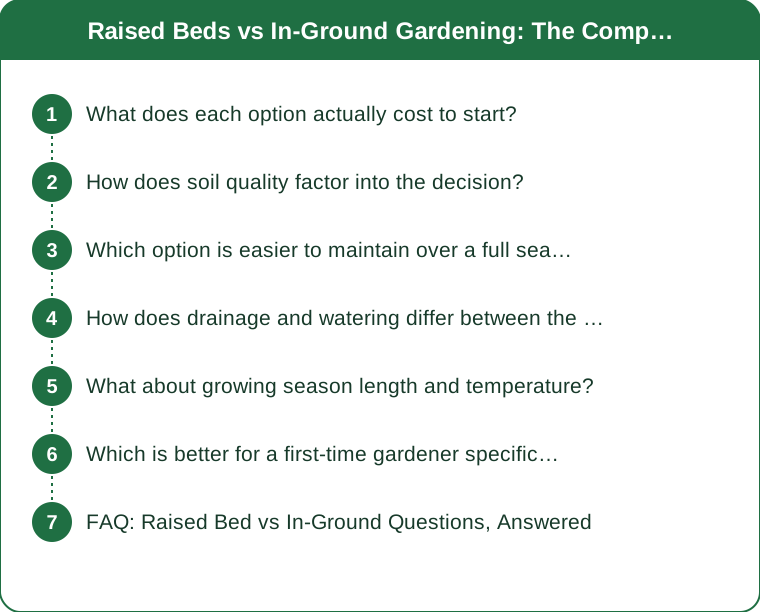
What does each option actually cost to start?
A basic in-ground plot mainly costs seeds, tools, and possibly soil amendments — often under $50 to start a modest first bed if your native soil is workable.
Raised beds run considerably higher upfront, typically $100-400+ depending on materials (cedar, composite, or metal) and size, since you’re buying both the frame and the fill soil to go inside it. Over years, though, raised beds often need less amendment and replacement than repeatedly improving poor native soil, somewhat narrowing the long-term cost gap.
How does soil quality factor into the decision?
This is the single biggest deciding factor for most new gardeners. If your native soil is heavy clay, very sandy, rocky, or contaminated (common in older urban lots with lead history), a raised bed lets you start with quality soil immediately rather than spending 1-3 seasons amending native soil to a workable state.
If a soil test shows decent, workable native soil already, in-ground gardening skips the raised bed cost entirely with comparable results — a simple home soil test kit or local extension office test is worth doing before committing either way.
Which option is easier to maintain over a full season?
Raised beds generally win on weeding and back comfort — the contained, elevated soil grows fewer windblown weed seeds than open ground, and the height reduces bending for planting, weeding, and harvest, which matters a lot for anyone with knee or back limitations.
In-ground beds require more consistent weeding effort and full bending/kneeling for most tasks, but offer more flexibility to simply expand the plot size in future seasons without buying more frame materials.
How does drainage and watering differ between the two?
Raised beds drain faster due to their elevated structure, which is a real advantage in heavy clay or high-rainfall areas prone to waterlogging — but that same fast drainage means raised beds also dry out faster and typically need more frequent watering than in-ground plots, especially in hot climates.
In-ground beds retain moisture longer between waterings in most conditions, which can mean less frequent watering but a higher risk of waterlogging if your native soil doesn’t drain well to begin with — matching the choice to your specific climate and soil type matters more than a universal rule.
What about growing season length and temperature?
Raised beds warm up faster in spring since the elevated soil isn’t insulated by the surrounding ground, which typically allows earlier planting by 1-2 weeks compared to in-ground beds in the same climate — a real advantage for gardeners in shorter-season regions.
That same faster warming means raised beds can also overheat roots faster during peak summer heat in hot climates, sometimes requiring mulch or partial shade cloth that in-ground beds need less often.
Which is better for a first-time gardener specifically?
For most first-time gardeners, raised beds offer a gentler learning curve — the contained soil is easier to get right from day one, weeding is less overwhelming, and the clear boundaries make planning and rotation simpler to visualize than an open in-ground plot.
The main reason to start in-ground instead is budget or wanting to test whether gardening sticks as a hobby before investing in bed materials — a small, simple in-ground test bed is a reasonable low-commitment starting point too.
FAQ: Raised Bed vs In-Ground Questions, Answered
Can you convert an in-ground garden to raised beds later?
Yes, easily — many gardeners start in-ground and add raised beds later once they know their space and preferences better, without any wasted effort from the in-ground season.
Do raised beds really produce better yields?
Not inherently from the structure itself — the yield advantage comes from the improved soil quality raised beds make it easier to achieve, which in-ground beds with equally good native soil can match.
Is a hybrid approach realistic — some raised, some in-ground?
Yes, and it’s a common approach — many experienced gardeners use raised beds for delicate or high-value crops and in-ground space for larger, less soil-sensitive plants like squash or corn.
TL;DR:
- Raised beds cost more upfront but offer better soil control, drainage, and less bending
- In-ground gardening is cheaper to start and works well if your native soil already tests decent
- Raised beds warm faster in spring but dry out and overheat faster in summer
- A hybrid approach — raised beds for delicate crops, in-ground for space-hungry ones — is a realistic middle path
Test your native soil before deciding either way — that single step resolves most of the uncertainty in this choice.
Keep Reading
This article is for general informational and styling purposes only. Fit, sizing, and product availability may vary.