Why Your Raised Bed Soil Sinks 6 Inches in the First Year (And What to Add Back)
Quick Answer: Raised bed soil typically sinks 4-8 inches in its first year as organic matter decomposes and air pockets compress. This is normal and expected — top it off each spring with a compost-heavy mix rather than assuming you did something wrong.
You filled the bed to the brim in April, and by September it looks like it lost a third of its volume. New gardeners often panic and assume they bought bad soil or that something is leaching out. In reality, this is one of the most predictable things a raised bed does.

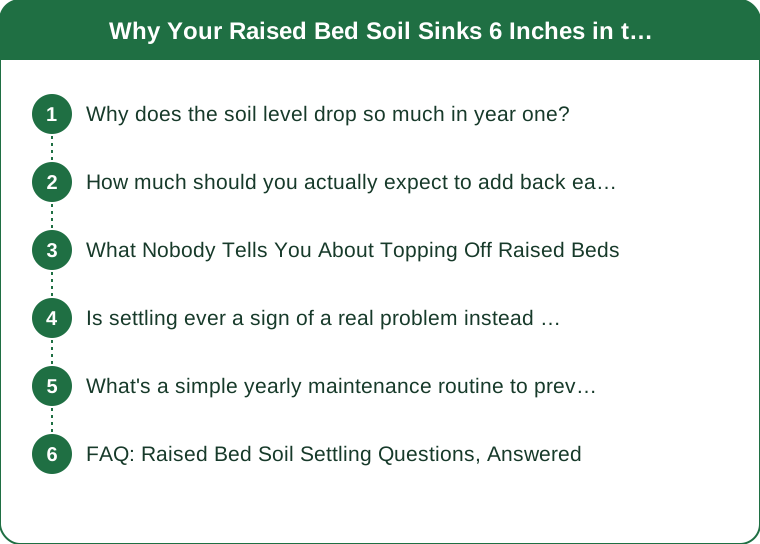
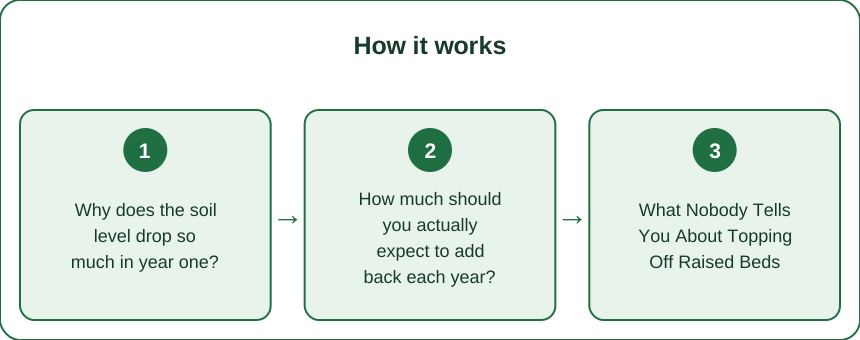
Why does the soil level drop so much in year one?
Fresh raised bed mix is usually 30-50% organic matter — compost, aged manure, peat or coir — and organic matter is constantly breaking down into smaller particles and, eventually, gas and water that leave the bed. A mix that’s mostly compost can lose a quarter of its volume in a single season just from decomposition, on top of settling from watering and rain compacting loose fill.
Mineral soil (sand, silt, clay) barely shrinks this way because it doesn’t decompose. That’s why a bed filled with heavy topsoil settles less than one filled with a rich, fluffy compost blend — the trade-off is that the compost-heavy mix grows better plants in year one, then needs replenishing.
How much should you actually expect to add back each year?
2-4 inches of new material annually is a reasonable range for an actively gardened bed, more in year one when the initial settling is steepest. A bed that started at 12 inches deep might need 3-4 inches back after the first season, then taper to 1-2 inches in following years as the soil structure stabilizes.
Measure it rather than guess: mark the original fill line on the inside of the bed with a permanent marker when you first fill it, so each spring you can see exactly how much has been lost.
What Nobody Tells You About Topping Off Raised Beds
Here’s the part most raised-bed guides skip: don’t just add more of the same fluffy compost mix you started with. If you keep topping off with pure compost year after year, you can end up with a bed that’s almost entirely decomposed organic matter and very little mineral structure, which drains too fast and holds nutrients poorly.
A better long-term top-off blend is roughly half finished compost and half a heavier component — screened topsoil or a bagged garden soil with actual mineral content. This keeps the bed’s structure balanced instead of drifting toward all-compost over several seasons.

Is settling ever a sign of a real problem instead of normal decomposition?
Usually not, but there are two cases worth a second look. Uneven settling — one corner dropping much more than the rest — often means water is draining or pooling unevenly, which is worth checking for a low spot in your leveling. Sudden, dramatic loss (more than a third of the bed in a few weeks) after heavy rain can mean fill material is washing out through gaps in the bed’s base or sides, not just decomposing.
Normal, expected settling is gradual and even across the bed’s surface over the growing season — that’s decomposition working as it should.
What’s a simple yearly maintenance routine to prevent surprises?
- Mark the fill line the first year so you have a baseline to measure against
- Each early spring, add 2-4 inches of a half-compost, half-soil blend before planting
- Mix the new layer into the top few inches rather than just laying it on top, so roots access it faster
- Track it: a quick phone note each spring (“added 3 inches, mix X”) tells you if settling is accelerating or slowing over the years
FAQ: Raised Bed Soil Settling Questions, Answered
Do all raised beds settle the same amount?
No — beds filled with mostly compost or the lasagna/hugelkultur method (layered organic matter, including logs and branches at the bottom) settle more dramatically, sometimes a foot or more in year one, than beds filled with a denser commercial raised-bed mix.
Should I fill a new bed higher than I want it to end up?
A reasonable practice is overfilling by about 15-20% above your target level, anticipating the first season’s settling, rather than filling exactly to the rim and being surprised.
Does settling mean I’m losing nutrients too?
Some nutrients cycle out as organic matter decomposes, which is part of why an annual compost top-off does double duty — it replaces lost volume and replenishes fertility at the same time.
TL;DR:
- 4-8 inches of settling in year one is normal, driven by organic matter decomposition, not a mistake
- Mark your fill line at planting so you can measure actual loss instead of guessing
- Top off with a half-compost, half-soil blend, not pure compost, to keep the bed’s structure balanced long term
- Uneven or sudden dramatic settling is worth investigating; slow and even settling is just the bed doing what it does
Treat the first year’s settling as expected maintenance, not a failure — every raised bed does this, and topping off is just part of the yearly rhythm.
Keep Reading
This article is for general informational and styling purposes only. Fit, sizing, and product availability may vary.