How Deep Does Your Raised Bed Soil Actually Need to Be? A Crop-by-Crop Guide
Quick Answer: Raised bed depth needs vary significantly by crop — leafy greens and herbs do fine in 6-8 inches, most vegetables need 10-12 inches, and root crops like carrots or parsnips need 14-18 inches for proper development. Building to the deepest crop you plan to grow avoids costly rebuilding later.
The generic ‘12 inches is enough’ advice you’ll find everywhere is a reasonable average, but it quietly shortchanges root vegetables and wastes soil and money if you’re only growing lettuce.
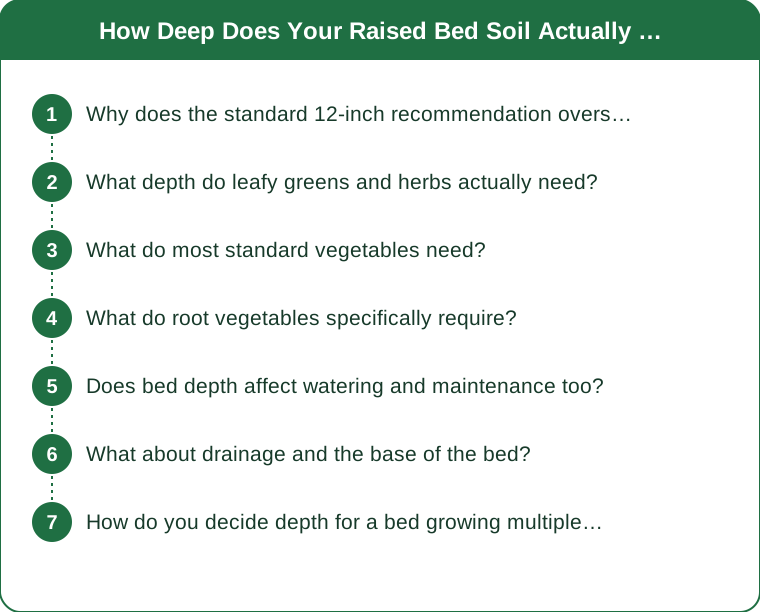
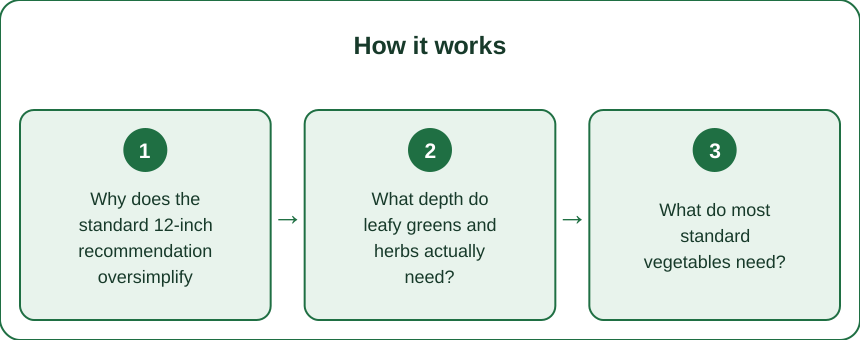
Why does the standard 12-inch recommendation oversimplify things?
Because it treats all vegetables as having the same root architecture, when they don’t. A 12-inch bed is genuinely excessive for lettuce, basil, or radishes, whose functional root zones rarely extend past 6-8 inches even at full maturity. For those crops, 4 extra inches of soil is just added cost and weight with no yield benefit.
Meanwhile, that same 12 inches is genuinely tight for carrots, parsnips, or daikon radish, which need 14-18 inches of loose, rock-free soil to grow straight rather than forking or stunting against compacted subsoil or the bed’s base. Building one depth for every crop means either overspending on shallow-rooted plants or undersizing your root vegetables — matching depth to what you’ll actually grow avoids both problems.
What depth do leafy greens and herbs actually need?
6-8 inches is sufficient for lettuce, spinach, kale, arugula, basil, cilantro, and most culinary herbs. These crops have relatively shallow, fibrous root systems focused on nutrient uptake near the surface rather than deep anchoring.
This is genuinely good news for gardeners on a budget or working with limited soil-fill budgets — a shallow bed dedicated to greens and herbs performs just as well as a deep one, at a fraction of the soil cost. If your garden is primarily salad greens and cooking herbs, don’t over-build depth you won’t use.
What do most standard vegetables need?
10-12 inches covers the bulk of common garden vegetables: tomatoes, peppers, beans, squash, cucumbers, and broccoli all develop adequate root systems in this range, especially if the native soil beneath the bed isn’t heavily compacted (roots often extend below the built bed into loosened native soil, effectively adding depth for free).
This is why the generic ‘12 inches’ advice persists — it’s a solid, safe average for a mixed vegetable garden, even though it’s not optimal for every individual crop within that garden.
What do root vegetables specifically require?
14-18 inches minimum for carrots, parsnips, and daikon radish; slightly less (10-12 inches) works for shorter root crops like beets and standard radishes. Root vegetables are the most depth-sensitive category because their edible portion is the root — any obstruction (rocks, compacted clay, the bed’s hardware cloth base) causes visible forking, stunting, or misshapen harvests.
If you’re building a mixed bed and don’t want to dedicate a full 18-inch structure to root crops alone, a practical compromise is double-digging or loosening the native soil beneath a 10-12 inch raised frame — this often achieves functionally similar depth without the material cost of a taller frame.
Does bed depth affect watering and maintenance too?
Yes, meaningfully. Deeper beds hold more moisture reserve and need less frequent watering than shallow ones, since a larger soil volume buffers against rapid drying — a real advantage in hot climates or for gardeners who can’t water daily.
The tradeoff is cost and weight: soil is heavy and not cheap, and an 18-inch bed can require 50% more fill volume than a 12-inch bed of the same footprint. For most home gardeners, building to 12 inches as a base and adding depth only where a specific crop (usually root vegetables) genuinely needs it is the more economical approach than uniformly maximizing depth everywhere.
What about drainage and the base of the bed?
Depth only helps if drainage is adequate — a deep bed with poor drainage just creates a bigger volume of waterlogged soil, which is worse for roots than a shallow, well-drained one. Avoid solid-bottom liners; if lining against pests, use hardware cloth (which allows drainage) rather than impermeable plastic sheeting.
Also consider that native soil beneath the bed matters even when you’ve built a raised frame — heavily compacted clay beneath a bed effectively creates a false floor that limits root depth regardless of how much soil you’ve added on top. Loosening the native soil with a broadfork before filling the bed lets roots access depth well beyond what you paid to fill.
How do you decide depth for a bed growing multiple crop types?
Build to your deepest planned crop, or use zoned beds. If root vegetables are part of your plan, either build the whole bed to 14-18 inches, or create a dedicated deeper zone or separate bed just for root crops while keeping the main bed at the more economical 10-12 inches for everything else.
Many experienced gardeners find that a single dedicated ‘root vegetable bed’ at full depth, paired with shallower beds for greens and standard vegetables, is more cost-effective over time than uniformly building every bed to accommodate the deepest-rooted crop you might ever grow.
TL;DR:
- Leafy greens and herbs: 6-8 inches is genuinely sufficient — don’t overbuild
- Standard vegetables (tomatoes, peppers, beans): 10-12 inches covers most needs
- Root vegetables like carrots and parsnips: 14-18 inches, or they fork and stunt
- Loosening native soil beneath the bed effectively adds free depth
- Match depth to what you’ll grow rather than maximizing everywhere — it saves real money on fill soil
Build your main beds at the economical 10-12 inch standard, then add a dedicated deeper zone only where root vegetables need it.
Keep Reading
This article is for general informational and styling purposes only. Fit, sizing, and product availability may vary.