The 7 Reasons First-Year Raised Bed Gardens Actually Fail (And How to Fix Each One)
Quick Answer: The most common first-year raised bed failures come down to soil depth, drainage, sun exposure miscalculation, overcrowding, watering inconsistency, ignoring soil testing, and unrealistic plant selection for the space. Each has a specific, fixable cause — first-year failure is rarely about lacking a green thumb.
You built the bed, filled it with soil, planted with enthusiasm, and by midsummer half of it looked worse than the bare yard did before. That’s an extremely common first-year experience, and nearly every version of it traces back to one of a handful of specific, fixable causes.

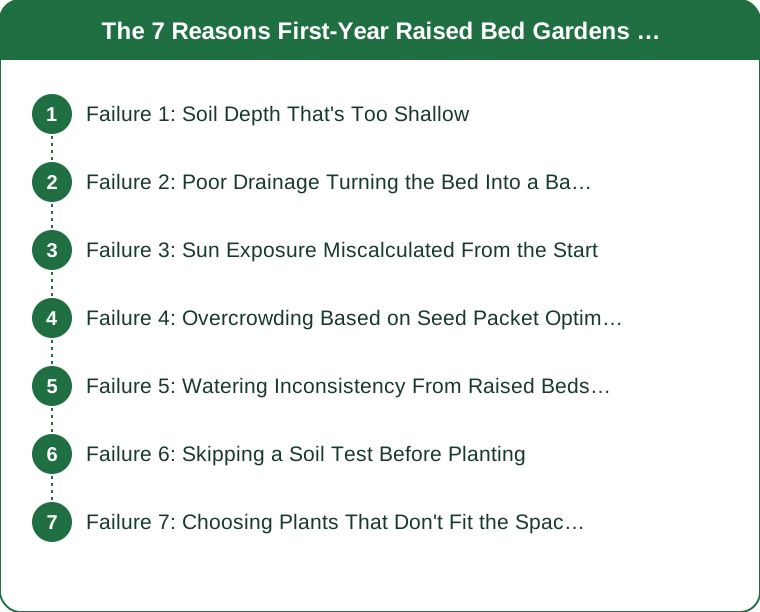
Failure 1: Soil Depth That’s Too Shallow
Many first-time raised beds are built at 6-8 inches deep, which works for shallow-rooted herbs and lettuces but starves anything with deeper root needs — tomatoes, peppers, and most root vegetables genuinely need 12-18 inches of quality soil to develop properly.
The fix for an existing shallow bed isn’t necessarily rebuilding — adding a soil-depth extension frame on top of the existing bed can retrofit the depth without starting over. For new beds, build to at least 12 inches from the start if you plan to grow anything beyond shallow greens.
Failure 2: Poor Drainage Turning the Bed Into a Bathtub
A raised bed built directly over compacted clay or hardpan soil, without any drainage consideration, can trap water at the base and effectively drown roots during heavy rain — a surprisingly common oversight since raised beds are often assumed to drain automatically simply by being elevated.
Breaking up the native soil layer beneath the bed before filling it, or adding a coarse gravel layer at the very bottom in poor-draining locations, prevents this. If an existing bed stays soggy for days after rain, this is very likely the cause.
Failure 3: Sun Exposure Miscalculated From the Start
Most vegetables need 6-8 hours of direct sun daily, but many first-time gardeners site their bed based on convenience (near a door, in an already-cleared corner) rather than actually tracking sun exposure across a full day before building. A bed that gets 3-4 hours of dappled shade looks fine in spring but produces disappointing yields by midsummer.
Before committing to a bed location, track sun hours across a full day, ideally in the season you’ll actually be growing — spring sun patterns shift significantly by summer as tree canopies fill in.

Failure 4: Overcrowding Based on Seed Packet Optimism
Seed packet spacing recommendations assume ideal, unlimited garden space — in a raised bed’s confined footprint, following packet spacing literally often results in dramatic overcrowding, competition for nutrients, and poor air circulation that invites disease.
For raised beds specifically, square-foot gardening spacing guidelines (which account for the bed’s improved soil density and confined layout) tend to produce healthier results than standard row-based seed packet instructions.
Failure 5: Watering Inconsistency From Raised Beds Drying Faster
Raised beds dry out noticeably faster than in-ground plots because they’re elevated and exposed to air on all sides, not just the top — a watering schedule copied from in-ground gardening experience often under-delivers water to a raised bed, especially in hot weather.
Check soil moisture by hand 2 inches down rather than relying on a fixed schedule; raised beds in full summer sun often need water every 1-2 days versus every 3-4 for equivalent in-ground plots.
Failure 6: Skipping a Soil Test Before Planting
Bagged garden soil and compost blends vary significantly in pH and nutrient content between brands, and assuming any bagged “garden soil” is automatically balanced for your specific plants is a common, costly assumption. A simple soil pH test kit (inexpensive and available at most garden centers) takes the guesswork out before you’ve invested a season’s effort.
Most vegetables prefer a pH between 6.0-7.0 — testing before planting lets you amend early rather than troubleshooting stunted growth mid-season without knowing why.
Failure 7: Choosing Plants That Don’t Fit the Space or Climate
Sprawling plants like squash or melons can overwhelm a small raised bed’s footprint within weeks, shading out neighboring plants and making the whole bed harder to manage. Similarly, choosing varieties not suited to your specific climate zone (a long-season tomato in a short growing region) sets up disappointment regardless of care quality.
For a first raised bed, choosing compact or bush varieties bred specifically for container and raised-bed growing, matched to your local growing zone, meaningfully increases first-year success odds over standard varieties.
FAQ: How do I know if my raised bed’s soil depth is actually the problem?
If plants with deep root needs (tomatoes, peppers) show stunted growth or wilting despite adequate water, shallow soil depth is a strong suspect worth checking with a simple probe test.
Can a poorly draining bed be fixed without rebuilding it?
Often yes — breaking up compacted soil beneath the bed or adding drainage amendments to the existing mix can improve it without a full rebuild, though severe cases may need it.
Is it too late to fix sun exposure issues for plants already growing?
Relocating an established bed mid-season isn’t practical, but choosing more shade-tolerant crops for that spot next season, or adding reflective mulch to maximize available light, can help salvage the current season.
TL;DR:
- Shallow soil depth, poor drainage, and miscalculated sun exposure are the top three structural failure points
- Overcrowding from seed-packet spacing and inconsistent watering are the most common care mistakes
- A basic soil pH test before planting prevents a season of unexplained stunted growth
- Matching plant variety to your bed’s actual size and climate zone matters as much as care quality
Keep Reading
This article is for general informational and styling purposes only. Fit, sizing, and product availability may vary.