The Late August Garden Decisions That Decide Next Spring
Quick Answer: The last fortnight of August and the first of September is the highest-leverage window in the whole gardening year. Soil is still warm enough for root growth, autumn rain is coming, and anything planted or amended now has 8 to 10 weeks of root development before the ground cools. What you do in this window shows up in April, not September - which is exactly why it gets skipped.
The three that matter most: sow cool-season crops now rather than later, get compost onto beds while soil biology is still active, and decide what to cut back versus leave standing.
Most gardens fail their spring not because of what happened in spring but because of what did not happen in late August.

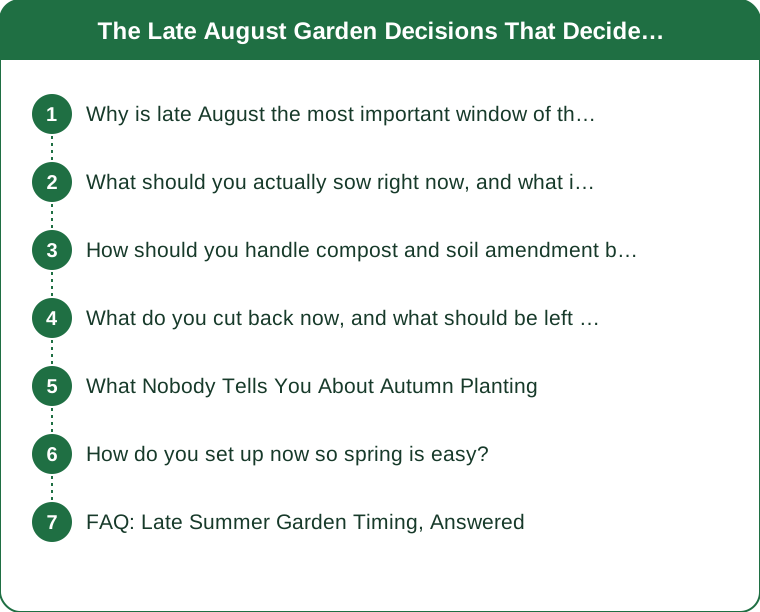
Why is late August the most important window of the gardening year?
Because it is the only point in the calendar when warm soil and increasing moisture happen at the same time.
The soil temperature situation. Soil holds heat far longer than air. In most temperate regions, soil at 10cm depth in late August is still running 18 to 22C even as night air drops into single digits. Root growth continues actively above about 10C, which means anything planted now has roughly two months of underground development before the ground genuinely cools.
The moisture situation, which is the other half. Late summer is typically the end of the dry period. Autumn rainfall arrives just as newly planted roots need it most, which is why autumn plantings so often outperform spring ones despite feeling counterintuitive. A spring-planted perennial faces increasing heat and decreasing water; an autumn-planted one faces the opposite.
The competition situation. Weed pressure drops sharply after mid-August. Annual weeds are setting seed and dying rather than germinating aggressively, which means a bed cleared now stays cleaner than the same bed cleared in May.
What this combination produces:
- Perennials planted now establish roots through autumn and emerge in spring already anchored, typically flowering a full season earlier than spring-planted equivalents
- Compost applied now is worked in by soil organisms over autumn, rather than sitting on the surface as it does in cold weather
- Cool-season crops sown now mature in the falling light of September and October, which produces better flavour in leafy greens than the rising light of spring
- Soil structure repairs itself over winter if it is opened up and amended now
The reason it gets missed. By late August most gardeners are tired, the garden looks tatty, and the payoff is eight months away. The gap between effort and visible reward is the longest of the year, and that is a genuinely hard thing to work against. But this is the window where the compounding happens.
What should you actually sow right now, and what is already too late?
The deciding number is your first frost date, counted backwards.
The calculation everybody should do once. Find your average first frost date, then count backwards by the crop days-to-maturity plus 14 days. The extra fortnight accounts for the fact that autumn growth is slower than the seed packet assumes, because days are shortening rather than lengthening. Seed packets are written for spring conditions and consistently understate autumn timelines by 10 to 20 percent.
Still worth sowing in late August in most temperate zones:
- Spinach (40 to 45 days). Genuinely better in autumn than spring - cold improves the flavour and there is no bolting pressure
- Radish (25 to 30 days). Fast enough that timing is barely a question. Autumn radishes are less woody
- Rocket and mustard greens (30 to 40 days). Sharper and better textured in cool weather
- Lettuce (45 to 55 days for looseleaf). Choose looseleaf over head types now; heads need more time than remains
- Turnips and pak choi (40 to 50 days). Both improve after light frost
- Coriander (45 days). This is the season it stops bolting instantly, which is the only reason it ever works
- Overwintering onions and garlic in the coming weeks, which is a different category - they are planted now to sit dormant
Already too late almost everywhere:
- Anything fruiting: tomatoes, peppers, courgettes, cucumbers, beans. These need warmth to ripen, and warmth is what is leaving
- Brassica heads from seed - cabbage, broccoli, cauliflower. From transplants you may still manage it; from seed you will not
- Carrots in cold-winter zones, though in mild zones they will hold in the ground all winter
- Winter squash, which needed sowing in June
The technique detail that matters in late-summer sowing. Soil surface temperature can still exceed 30C, and lettuce seed goes dormant above roughly 27C. Sow in the late afternoon, water the furrow before sowing rather than after, and shade the row for the first few days. More late-summer sowings fail from heat dormancy than from anything else, and people usually blame old seed.
How should you handle compost and soil amendment before winter?
Apply now, on the surface, and let the soil do the work over autumn.
Why now beats spring. Soil biology is temperature-dependent. Bacterial and fungal activity peaks in warm, moist soil - which is exactly what late August and September provide. Compost applied now is incorporated by earthworms and microbes over 8 to 12 weeks. The same compost applied in March sits largely unprocessed while cold soil biology is still waking up.
The method, which is simpler than most advice suggests:
- 2 to 5cm of compost spread on the surface. Do not dig it in
- Water it once if the weather is dry, to start biological activity
- Cover with mulch or leave to the autumn leaf fall, either of which protects the surface
Why not to dig it in. Digging destroys fungal networks and soil aggregate structure that took a season to build. Earthworms move surface organic matter down more effectively than a fork does, and without the structural damage. The no-dig evidence here is strong enough that it has become the default in most serious growing advice over the last decade.
The one case for digging: genuine compaction, such as a bed that was walked on all summer or is newly built on subsoil. Even then, loosen with a fork without inverting - push in, lever slightly, withdraw. You are creating fissures, not turning the soil over.
On cover crops, which are the underrated move:
- Sown into empty beds now, they root through autumn and hold soil structure and nutrients over winter
- Field beans and winter rye for cold zones; phacelia and crimson clover where winters are mild
- Cut down in spring and leave on the surface as a mulch, rather than digging in
- The nitrogen effect is real but slow - the structural and erosion benefits arrive first
On soil testing, which is worth doing precisely once every few years. Autumn is the correct time because pH amendments - lime especially - take months to act. Lime applied now affects spring pH; lime applied in spring affects almost nothing that season. A basic test costs very little and stops the guessing about why one bed always underperforms.

What do you cut back now, and what should be left standing?
The old advice was to cut everything down for tidiness. The current evidence says the opposite for most of it.
Cut back now:
- Anything diseased. Powdery mildew, blight, rust, black spot - remove and bin, do not compost. Most fungal pathogens overwinter on debris and re-infect from ground level next spring
- Spent annual vegetables, once they have stopped producing. They harbour pests and add nothing
- Perennials that collapse into a wet mush - hostas, daylilies. These rot rather than standing, and the mush shelters slugs
- Anything setting seed you do not want, which is a five-minute job now and a five-hour job next June
Leave standing through winter:
- Ornamental grasses and seed heads - echinacea, rudbeckia, sedum, teasel. These feed birds through the hardest months and look genuinely good under frost
- Hollow stems, which are overwintering habitat for solitary bees and beneficial insects. Cutting them in autumn removes next year’s pest control
- Anything marginally hardy. The dead top growth insulates the crown. Cut it in autumn and you expose the crown to freeze-thaw cycles, which is what actually kills borderline perennials rather than cold itself
- Leaf litter under shrubs and hedges, which is where most beneficial invertebrates overwinter
The compromise that works in a visible front garden. Cut the front metre, leave the back. The tidiness is where it is seen, the habitat is where it is not. This is not a lesser option - it retains most of the ecological benefit.
The timing rule for the leave-standing group. Cut in late winter or very early spring, before new growth starts but after the worst cold. Roughly when you see the first bulb tips. Doing it then gives the habitat benefit through winter and clears the way for spring.
What Nobody Tells You About Autumn Planting
The root growth is invisible and that is the entire problem. A perennial planted in September looks identical in November to one planted in November. Underground, it has built a root system three or four times larger, which is why it outperforms so dramatically in its first summer. You cannot see the thing you are paying for.
Nurseries discount in autumn because it is the end of their season, not because the plants are worse. Autumn stock is frequently root-bound and shabby-looking, and root-bound plants establish fine in autumn because there is time to sort themselves out before any real demand. The same plant in July would struggle. Autumn is when the plant discounts and the planting conditions coincide, which almost never happens in retail.
Watering matters more in autumn than people expect, and for a different reason. Autumn rain is unreliable in the first six weeks, and new plantings dry out even in cool weather because they have no root reach. Cool air makes you forget to check. Check the soil at 5cm depth weekly until proper autumn rain arrives - not the surface, which tells you nothing.
Mulching too early is a real mistake. Mulch applied while soil is still warm traps that warmth and keeps roots active later than is useful, and can shelter voles against tender bark. Wait until the soil has genuinely cooled - typically several weeks after the first frost - for winter-protection mulch. Compost applied now is different; that is a soil amendment, not insulation.
The bulb window is later than people plant it. Most people plant spring bulbs in September because that is when the shops stock them. Tulips in particular do better planted in late October or November, when the soil has cooled enough to suppress the fungal diseases that cause bulb rot. Daffodils are the exception and genuinely prefer earlier planting.
How do you set up now so spring is easy?
The goal is that March requires decisions you have already made.
The bed-by-bed audit, which takes an hour and is the highest-value thing on this list. Walk the garden with a notebook and record, for each bed: what grew there this year, how it did, and what will follow it. Memory is far less reliable than gardeners think, and crop rotation collapses within two seasons without a written record.
What to write down while it is still visible:
- Which beds dried out first in the summer heat, and which stayed damp. This is your irrigation and planting map
- Where the shade actually fell in July, which is different from where you assumed
- What failed and the honest reason - too late, too dry, too crowded, wrong spot
- What produced more than you could use. Growing less of something is a legitimate improvement
Physical preparation that pays off:
- Clean and oil tools now, while you remember which ones are blunt
- Empty and store hoses before the first freeze. Split hoses are a spring tax nobody budgets for
- Order seed in autumn. The good varieties sell out by February, and autumn ordering is when the choice exists
- Fix beds and structures now. Repairing a raised bed in mild September weather is a pleasant hour; in March it is misery and it delays planting
The propagation opportunity most people miss. Late August and September is the best window for softwood and semi-ripe cuttings of many shrubs and perennials - lavender, rosemary, salvia, hydrangea. Take a 10cm cutting below a leaf node, strip the lower leaves, and put it in gritty compost. Rooting rates in this window are high, and it costs nothing. Overwinter them somewhere sheltered and you have plants in spring that would have cost real money.
The mental part, which matters more than it sounds. Do these tasks in small sessions rather than one exhausting weekend. Late-season garden work has no dopamine payoff, and the way it actually gets done is 40 minutes at a time across three weeks.
FAQ: Late Summer Garden Timing, Answered
Is it too late to plant perennials?
No - late August through September is arguably the best perennial planting window of the year. Warm soil plus coming rain means roots establish before winter, and those plants typically outperform spring-planted equivalents in their first full season. Give them 6 to 8 weeks before hard frost.
How do I know if it is too late to sow a crop?
Count backwards from your average first frost date using the days-to-maturity on the packet, then add 14 days. Autumn growth is slower than the packet assumes because days are shortening. If the number does not fit, choose a faster crop rather than sowing hopefully.
Should I dig compost into my beds?
No. Spread 2 to 5cm on the surface and let earthworms and soil biology incorporate it over autumn. Digging destroys soil structure and fungal networks. The only exception is genuine compaction, and even then loosen with a fork without turning the soil over.
Why did my late-summer lettuce seed not germinate?
Almost certainly heat dormancy - lettuce seed goes dormant above about 27C, and soil surface temperature in late August frequently exceeds that. Sow late in the day, pre-water the furrow, and shade the row for the first few days. Old seed usually gets blamed unfairly.
What should I not cut back this autumn?
Seed heads and ornamental grasses (bird food), hollow stems (overwintering bees), and the dead top growth of marginally hardy perennials (crown insulation). Cut those in late winter instead. Do cut anything diseased, and bin rather than compost it.
When should I plant spring bulbs?
Daffodils from September. Tulips are better in late October or November, once the soil has cooled - planting them early increases the risk of fungal bulb rot. The shops stock them all in September, which is why so many people plant tulips too early.
TL;DR:
- Late August is the highest-leverage window of the year: warm soil plus coming rain means roots establish fast
- Sow fast cool-season crops now (spinach, radish, rocket, looseleaf lettuce); fruiting crops are done
- Spread compost on the surface and let soil biology work it in over autumn - do not dig
- Cut diseased material and collapsing perennials; leave seed heads, hollow stems, and hardy top growth standing
- Do the bed-by-bed audit while you can still see what happened, and take cuttings while the window is open
Nothing you do now looks like anything in September. It all shows up in April, which is exactly why the people with good spring gardens are the ones out there in late August.
Keep Reading
This article is for general informational and styling purposes only. Fit, sizing, and product availability may vary.