Why Keeping a Garden Journal Is the Single Best Beginner Habit You're Skipping
Quick Answer: A garden journal that tracks what was planted, when, where, and how it performed turns each season into usable data rather than a hazy memory, which is the difference between repeating the same avoidable mistakes every year and actually improving results season over season — and it requires nothing more than a notebook and five minutes a week.
Most gardening advice focuses on what to plant and how, but the habit that compounds fastest over multiple seasons is simply writing down what actually happened.

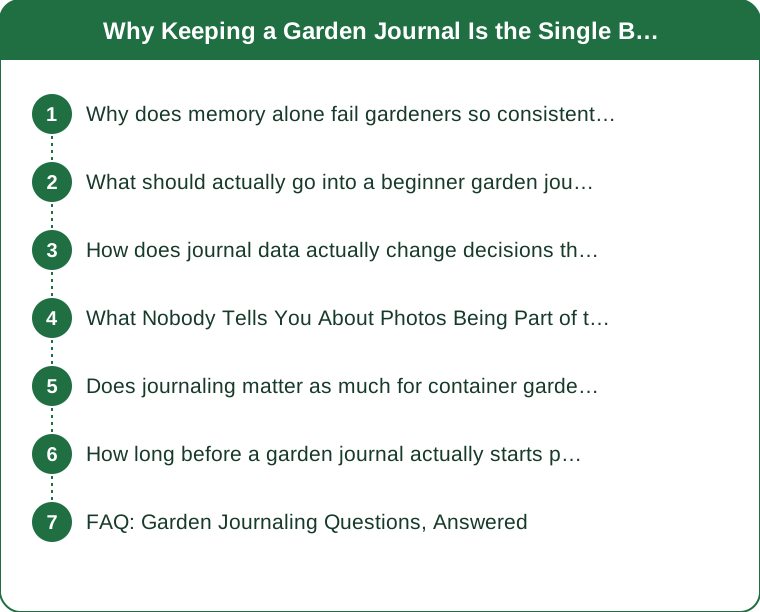
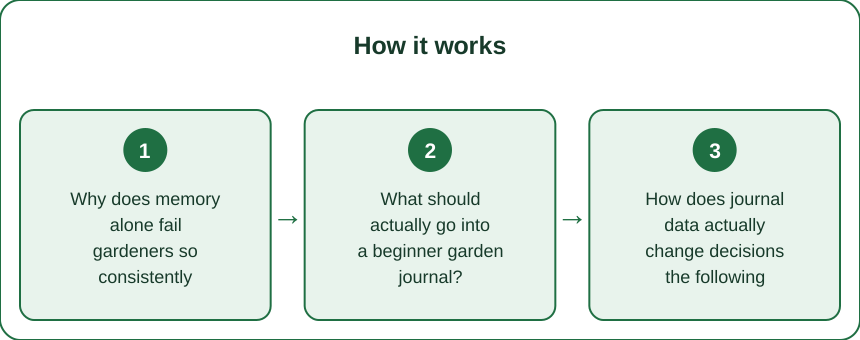
Why does memory alone fail gardeners so consistently season to season?
A single growing season involves dozens of small decisions and outcomes — when specific seeds were started, which varieties struggled in a particular bed’s light conditions, when a pest problem first appeared — and by the following spring, most of that specific detail has faded into a vague general impression, making it easy to repeat the same timing mistakes or plant the same underperforming variety again without realizing it.
What should actually go into a beginner garden journal?
The core useful entries are planting dates, specific variety names (not just ‘tomatoes’ but the specific cultivar), bed or container location, and periodic notes on how each plant is performing — a few lines every week or two, rather than an elaborate daily log, captures most of the value without becoming its own burdensome chore.
How does journal data actually change decisions the following season?
Reviewing the previous year’s entries before planning a new season reveals concrete patterns — a variety that consistently underperformed in a specific bed’s afternoon shade, a planting date that was clearly too early based on a late frost that damaged seedlings — information specific enough to actually change next season’s plan, rather than generic advice that doesn’t account for your particular garden’s conditions.

What Nobody Tells You About Photos Being Part of the Journal Too
Written notes alone often miss visual details that turn out to matter — the exact color of a nutrient deficiency on leaves, how much a particular bed’s light changed as a nearby tree filled in over the season — a quick photo taken alongside written notes, even just on a phone with the date noted, adds a layer of detail that pure text entries tend to miss.
Does journaling matter as much for container gardening as for larger in-ground plots?
Yes, arguably even more — container conditions (soil drying rate, specific sun exposure for that exact spot) are often more variable and location-specific than a larger in-ground bed, making season-to-season tracking particularly valuable for catching container-specific patterns that generic gardening advice won’t address.
How long before a garden journal actually starts paying off in better results?
Most of the real value compounds starting in year two, once you have a full season of your own specific data to compare against — a first-year journal mostly just establishes the baseline, while the second and subsequent seasons are where the pattern recognition and improved decisions actually kick in.
FAQ: Garden Journaling Questions, Answered
Is a physical notebook better than a gardening app for this?
Either works fine — the format matters far less than actually maintaining the habit consistently, so choosing whichever medium (paper or digital) you’re personally more likely to stick with is the better choice.
What if I forget to journal for a few weeks during a busy stretch?
A gap is completely fine and common — picking back up with a quick catch-up entry (even a rough reconstruction from memory) is far more valuable than abandoning the habit entirely over an imperfect record.
Do I need to track every single plant, or just the ones I’m unsure about?
Tracking everything, even plants that seem to be doing predictably well, is worth it since ‘predictable’ results are exactly the useful baseline data for noticing when something changes in a future season.
TL;DR:
- A garden journal turns vague seasonal memory into specific, usable data for future decisions
- Planting dates, variety names, and periodic performance notes are the core useful entries
- Photos alongside written notes catch visual details text alone tends to miss
- Most of the real payoff compounds starting in year two, once a full season of data exists
Of everything a beginner gardener can invest in, a simple journal is the cheapest and the one most likely to actually improve results year over year.
Keep Reading
This article is for general informational and styling purposes only. Fit, sizing, and product availability may vary.